Over Time (2000–2022)
Overview
Music streaming platforms have fundamentally changed how people discover, consume, and engage with music. As a result, the popularity of different music genres has shifted significantly over time, reflecting changes in technology, culture, and listening habits. This webpage explores how the popularity of major music genres has evolved from 2000 to 2022 using a dataset derived from Spotify.

Sample Track Data
This table presents a simplified excerpt of the original track-level dataset. To provide representative coverage across time, two sample tracks were selected from five key years (2000, 2005, 2010, 2015, and 2022). These examples highlight differences in genre distribution, popularity scores, and audio characteristics across different stages of the streaming era.
| year | track_name | track_popularity | artist_name | artist_genres | main_genre | artist_popularity | danceability | energy | liveness | valence | tempo | duration_ms |
|---|---|---|---|---|---|---|---|---|---|---|---|---|
| 2000 | Yellow | 91 | Coldplay | ['permanent wave', 'pop'] | Pop | 86 | 0.429 | 0.661 | 0.234 | 0.285 | 173.372 | 266773 |
| 2000 | The Real Slim Shady | 88 | Eminem | ['detroit hip hop', 'hip hop', 'rap'] | Hip-hop | 88 | 0.949 | 0.661 | 0.0454 | 0.76 | 104.504 | 284200 |
| 2005 | Gold Digger | 82 | Kanye West | ['chicago rap', 'hip hop', 'rap'] | Hip-hop | 89 | 0.629 | 0.696 | 0.0554 | 0.623 | 93.034 | 207627 |
| 2005 | We Belong Together | 73 | Mariah Carey | ['dance pop', 'pop'] | Pop | 76 | 0.837 | 0.462 | 0.09 | 0.762 | 139.986 | 201400 |
| 2010 | Just the Way You Are | 86 | Bruno Mars | ['dance pop', 'pop'] | Pop | 86 | 0.635 | 0.841 | 0.0622 | 0.424 | 109.021 | 220734 |
| 2010 | Love The Way You Lie | 85 | Eminem | ['detroit hip hop', 'hip hop'] | Hip-hop | 88 | 0.749 | 0.925 | 0.52 | 0.641 | 86.989 | 263373 |
| 2015 | Uptown Funk | 85 | Mark Ronson | ['pop soul'] | Pop | 72 | 0.856 | 0.609 | 0.0344 | 0.928 | 114.988 | 269667 |
| 2015 | The Less I Know The Better | 87 | Tame Impala | ['modern rock'] | Rock | 78 | 0.64 | 0.74 | 0.167 | 0.785 | 116.879 | 216320 |
| 2022 | As It Was | 90 | Harry Styles | ['pop'] | Pop | 85 | 0.52 | 0.731 | 0.311 | 0.662 | 173.93 | 167303 |
| 2022 | Anti-Hero | 93 | Taylor Swift | ['pop'] | Pop | 100 | 0.637 | 0.643 | 0.142 | 0.533 | 97.008 | 200690 |
Popularity Trends After 2010
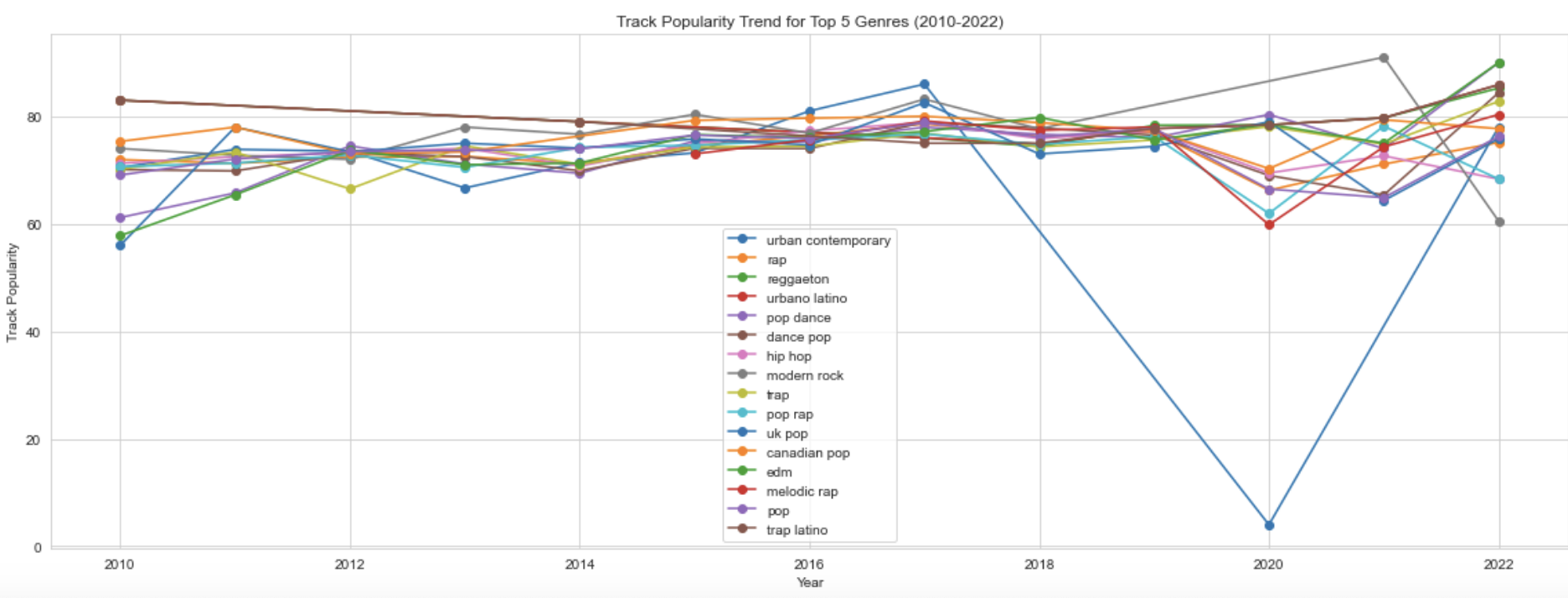
From 2010 to 2022, musical trends have evolved significantly. Although the energy and emotion indices as well as popularity data for EDM and Pop have fluctuated to some extent over the 22-year period, both genres ultimately remain the highest among all genres. Melodic Rap maintains a balanced appeal, and overall artist and track popularity highlight diverse audience tastes. This repository captures the dynamic journey of these genres over the years, offering a snapshot of the changing music landscape.
Energy & Audio Feature Shifts
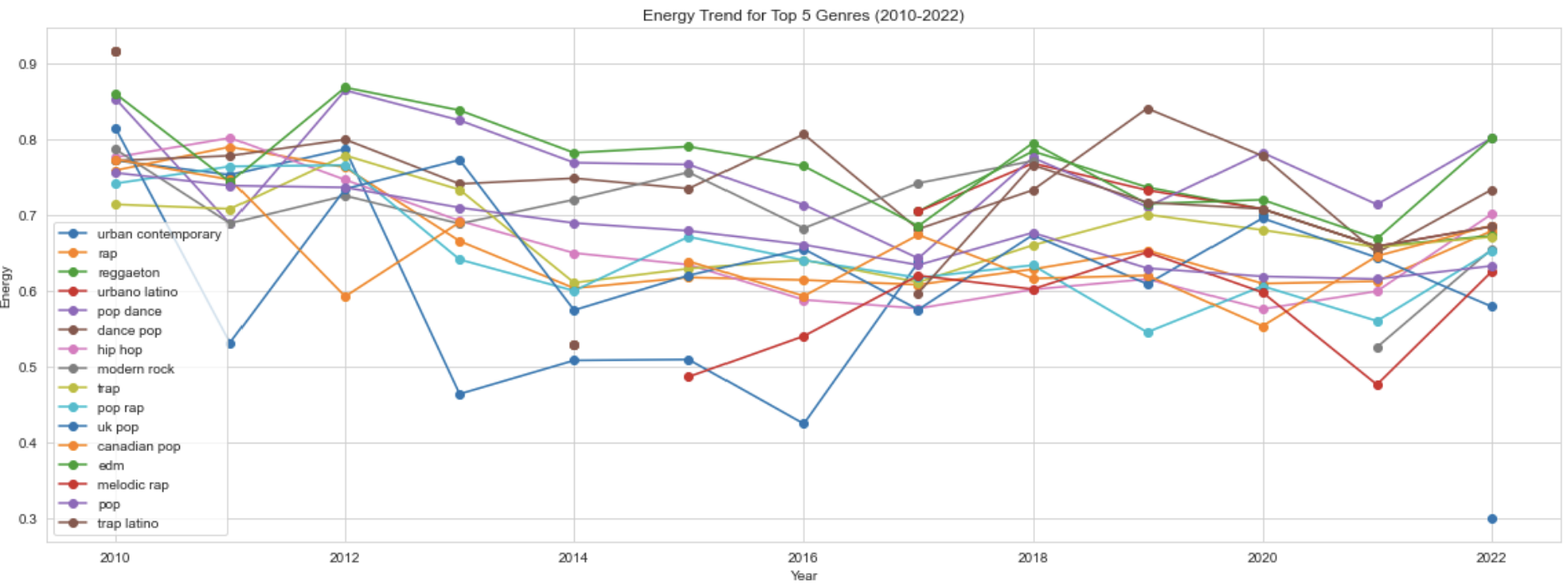
From 2010 to 2022, most genres maintain relatively high energy levels, generally between 0.6 and 0.8. Dance-oriented genres such as EDM and dance pop consistently show higher energy, while some pop and urban styles fluctuate more noticeably. Overall, the chart suggests that energetic, rhythm-driven music remains dominant throughout the streaming era.
Conclusion and Resources
From 2010 to 2022, Pop and Dance Pop remain the most dominant genres despite fluctuations, while Hip-hop sustains strong cultural influence in the streaming era.
The dataset used in this project is derived from the
Music Genre Trends Analysis (2010–2022) repository
published by Dhruv Strivedi on GitHub.
The dataset includes track-level information such as
track popularity, artist popularity, genre classifications,
and key audio features including danceability, energy,
valence, tempo, and duration.
These attributes were used to calculate yearly averages
and identify long-term genre trends.